All the best central air conditioning units with a high SEER rating to keep your home nice and cool.
The best central air conditioning units will put you on the path to a cooler home all-around. Unlike one of the best window air conditioners or one of the best portable air conditioners, central air conditioning units don’t just treat just one area. Your whole home, or at least several rooms, is set to benefit from a central air conditioning unit. That means that you can get on with your hobbies, chores, sleep and daily life free from sweat or stickiness. A good SEER rating is a staple for the best central conditioning units. This rating is what keeps your running costs as low as possible, so many of the following models have a rating of over 14.5 for optimal cost-cutting. The upfront cost of HVAC systems can seem quite daunting, and that may be the case with our top-rated central air conditioning unit from American Standard. However, the pay-off is well worth it. Just make sure that your central air conditioning unit has a warranty of five to 10 years at a minimum to keep your cooling system safe in the event of a breakdown.Another reason the best central air conditioning units have a higher price point is due to the extent of their cooling power. No key living spaces need to be left out with the Carrier, Goodman, Trane, and other models in our lineup, including bedrooms, kitchen, home gyms and studies. Throughout this guide to the best central air conditioning units, we’ll be highlighting the reputation of each brand within the AC industry, so you know you’re in safe hands, and not about to waste money on an unreliable appliance. We’ve highlighted the importance of installation processes too, as well as the length of each warranty and user feedback. For more ways to cool down your home to an optimal temperature.


American Standard is one of the leading brands in the HVAC industry, known for its variety of high performance, central air conditioners. They offer a range of reliable units with three series available – Platinum, Gold and Silver. Energy-efficient units start from the standard 14 SEER rating and can reach up to 22 SEER, which is the best for high efficiency and handy for saving on those electricity bills. The units are equipped with advanced features such as the Aero Quiet II System, and sound levels are super quiet.
The units are well engineered and built to perform under harsh conditions. American Standard are also known for their versatility and compact unit sizes, making their systems ideal for mobile homes.
Although unit prices are reasonable, installation can be costly, with fees ranging anywhere between $1000 and $5,000. However, American Standard’s exceptional 12-year compressor and 10-year parts warranties can save you money and time in the long-run.
We chose this as the best overall unit for its affordability, impressive features, and for the fact that it’s one of the quieter brands on the market.
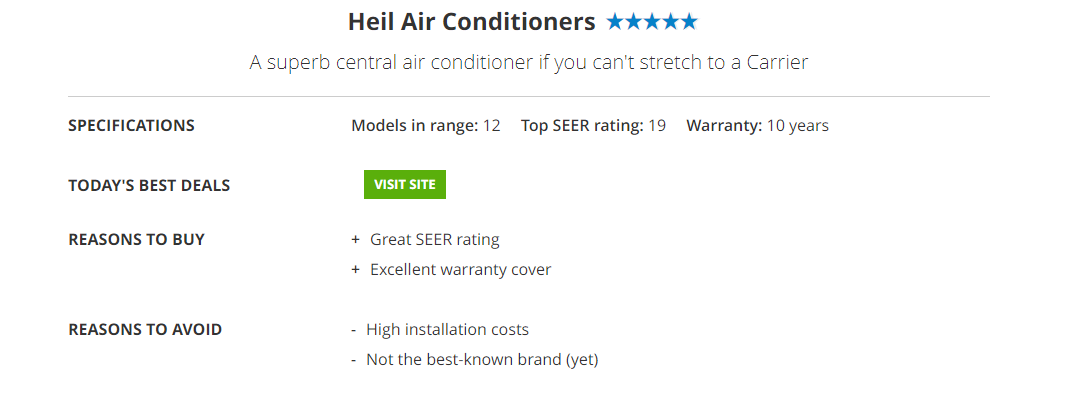
If you want peace of mind when buying a central air conditioning unit, we’d recommended Heil. That’s because the company offers up to a 10-year parts warranty, with some AC units also coming with an extended 10-year no-hassle full-unit replacement. That covers failure of the compressor, coil or heat exchanger. If either of those should fail, Heil will replace the entire unit, terms permitting.
Depending on the central air conditioner you opt for, you also get to enjoy a highly accomplished AC unit that delivers high SEER efficiency (up to 19) while running at super-quiet levels.
Our top pick for Heil’s best central air conditioning unit is the HVA9, which has a 5-stage variable compressor system and integrated acoustic dampening blanket. This particular air conditioner also supports the brand’s smart Wi-Fi Ion System Control touchscreen thermostat for added convenience.
The Heil HVA9 central air conditioning unit is top of the Ion range, but if you’re looking for something more affordable while retaining the warranty, consider the Heil HVA7. This cheaper HVAC system has the same 10-year no-hassle cover, while the HSA6 offers a five-year no-hassle warranty.
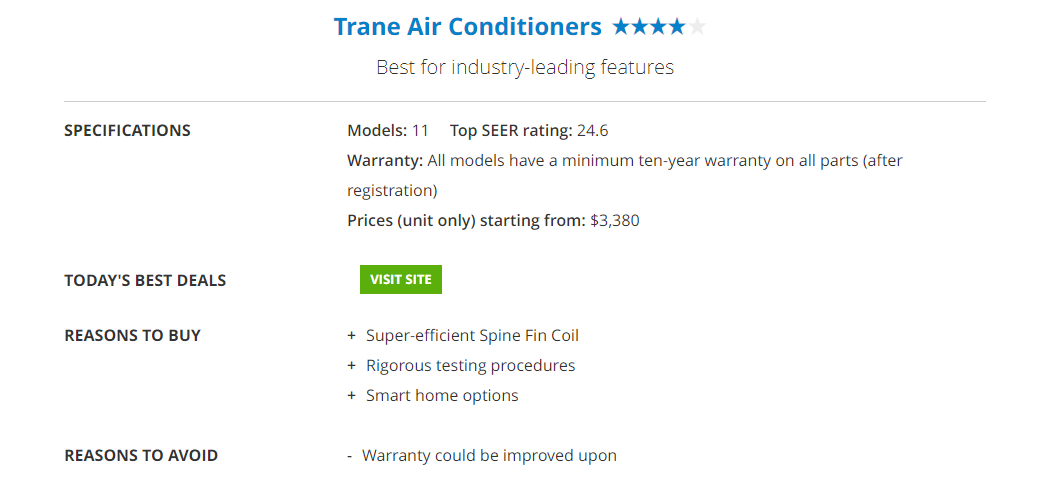
Since 2015 Trane has succeeded in being named ‘America’s Most Trusted HVAC System’ every year by Lifestory research, thanks to its dedication to delivering quality products. This commitment to excellence is obvious with its testing regime and an insistence on trained engineers installing and servicing its products for warranties to be valid. Aside from its accolades, another major factor that might sway you to pick Trane for your central air conditioning unit is the standout features on offer. Within certain models, the Spine Fin Coil goes a long way to aid with efficiency, as it allows for faster cooling. It’s also made with all aluminum which makes it more resistant to corrosion than copper alternatives. There’s also the chance to optimize your central air conditioning unit with certain Trane models, as some have thermostats that can be linked to smartphones thanks to Wi-Fi connection. That allows for ultimate control over your home’s temperature, as well as the chance to pair it with other smart devices, such as your smart speaker. Trane is certainly a reliable brand, and its range of prices is another good reason to take a look at what they have to offer. The warranties are all at least ten years from the date of purchase, though that does depend on registering your unit and keeping it serviced with Trane-certified dealers.
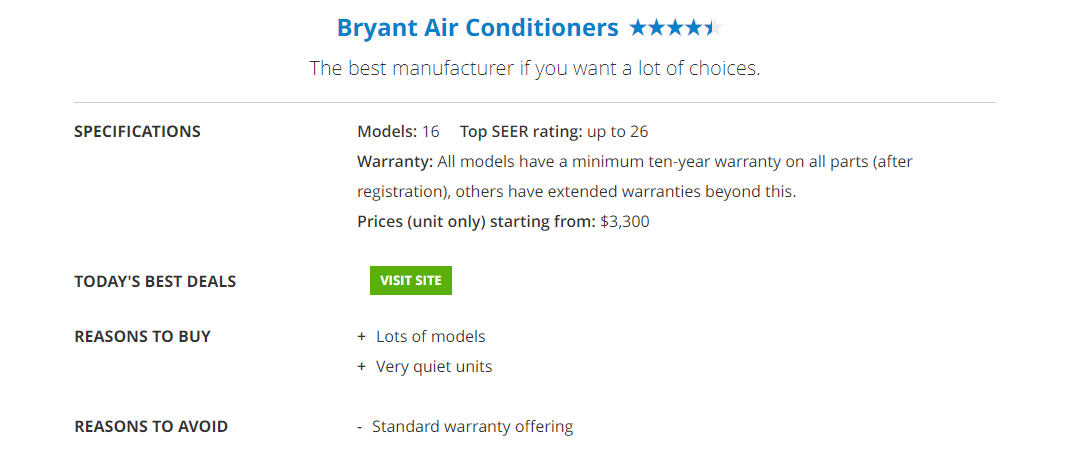
You’ll have plenty of choice if you decide that Bryant is the one for you, with 16 models to choose from, with a variation of SEER ratings and prices attached to them. No matter which one you opt for, Bryant air conditioners should deliver a coolness to your home to help you survive the summer. It’s important to note that Bryant comes under the ownership of United Technologies, meaning it won’t be surprising to find very similar products from competitors such as Carrier in their range. However, Bryant does tend to be a little more affordable than their counterparts and you’ll benefit from the fact that the installation process is standard across brands. There are affordable choices when it comes to Bryant’s thermostats too, with the option of a full-color touch screen display to accompany your unit for not too hefty a price. Or, if you want something a step above, then there are also Wi-Fi-enabled alternatives offering multi-zone control.Bryant is an all-around good choice if you want to shop around before you make your final decision, and don’t fall down when it comes to warranty either, with a standard ten-year guarantee (given that you register within the specified time period).

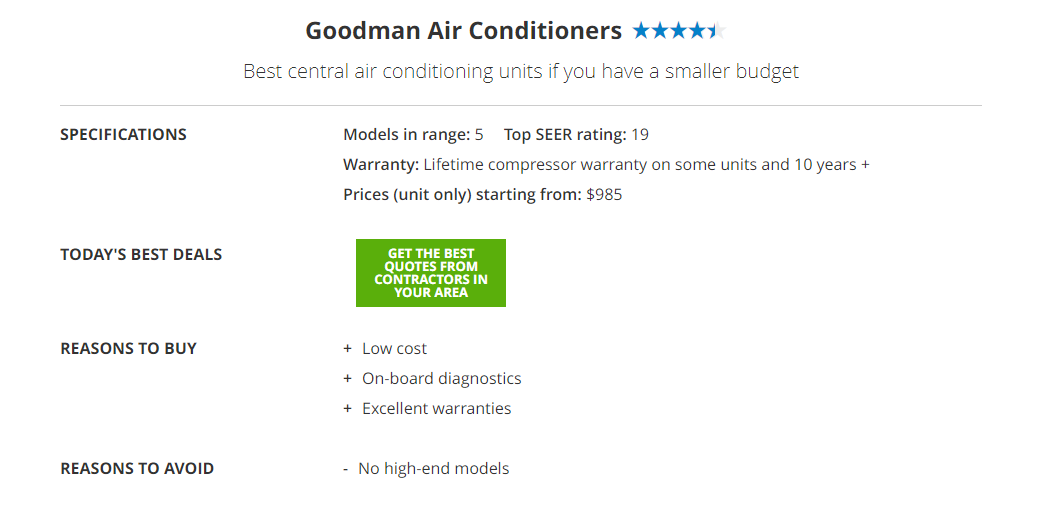
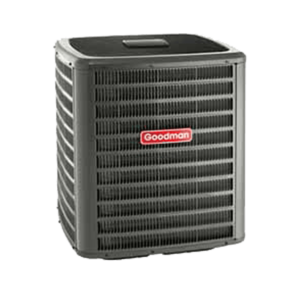
For a budget-friendly yet efficient central air conditioner, Goodman is the best brand. Offering five central air conditioning models, prices for a unit alone can start from as little as $985, although installation costs are not significantly cheaper than elsewhere. Despite its low costs, the company does not compromise on quality, and units are equipped with several handy features. An example would be the convenient onboard diagnostics that help with the maintenance and upkeep of the units.Users can store up to six fault codes which will notify them in the event of a developing problem. Goodman air conditioners are also quiet, ranging from 40 decibels normally, up to 70 decibels at the most.While you could find more energy-efficient brands on the market, you are still likely to make an overall saving. A real saving grace is Goodman’s excellent warranty coverage. They offer a 12-year compressor warranty on most models and 10-year warranty on others, which is better than many competitors. Reliable and efficient, Goodman air conditioners are ideal for those living in hotter environments who require comfort and value for money.
A central air conditioner stands to cool your home for the long haul, so it’s important that you make sure that your purchase is up to scratch. These are the key things to look for:
SEER - The SEER (Seasonal Energy Efficiency Ratio) rating should be your first consideration. To break things down simply, the higher the SEER rating, the more powerful your central air conditioner. So, where does the rating come from? It’s taken by dividing the cooling output of the unit by the running costs over one year. The SEER rating range for newer central air conditioning units is between 13 and 26, but the higher, the better.
Decibels (dB) - The decibels dictate how noisy your central air conditioner is. Generally, most central air conditioner units will sound a little like a vacuum cleaner or a washing machine when they are up and running, which is equivalent to around mid-70dB. If you care about the noise the machine makes, the best central air conditioning units will have a rating of mid-50dB, which sounds closer to a running dishwasher.
Features - Top features to look for in your central air conditioner include two-stage variable compressors and variable fan speeds for high-quality cooling. For those living in unpredictable climates, coastal models or enhanced weather protection can provide some relief. A wireless thermostat will also come in handy for keeping close tabs on your home’s temperature.
Warranty - A ten-year warranty will give your machine the greatest cover, especially considering that central air on fair investment. Always read over the details in the small print to make sure that you have an enhanced replacement cover for the whole unit. Regular services can also keep your unit in good working order.
The price of the best central air conditioner comes down to two main factors: the cost of the base unit, listed above, and the cost of installation. In our lineup, we have only covered the cost of the base unit and an estimate of the price range required for a basic installation. You won’t know the exact cost of the entire HVAC installation until you reach out for quotes from authorized contractors who can install your selected AC unit. Getting quotes from a handful of local contractors will give you a better idea of the exact cost of installation, because there are a lot of variables that come into play, such as the size of your home, the location of your home and its current infrastructure. On top of that, there will be a figure for the servicing contract afterward.The price of the base unit might be bumped up by features such as a high SEER rating, brand reputation, size and smart features. You should expect higher-end air conditioning brands to cost more to install, due to all of the premium parts required. If you take into account that the installation will cost somewhere between $2,000 and $6,000, and add on the base unit, you’ll soon have a better idea of the overall cost of your central air conditioning unit. Remember that any ductwork or a gas furnace replacement will bump up the costs further, as will a multi-zone system.
Central AC units with excellent energy efficiency ratings can save you more on your electricity bills than standard models. However, you can expect the highest efficiency models to be the most expensive upfront.
Air conditioners with exceptional cooling capabilities that also consume very little electricity earn high SEER (Seasonal Energy Efficiency Ratio) ratings. Compare the unit’s upfront cost with potential energy savings over time to see if it's worth the investment.
New air conditioners are much more energy efficient than older units though. While older AC units were typically rated around 8 to 9 SEER, the U.S. Department of Energy now requires a minimum of 13 SEER or 14 SEER for central air conditioners, depending on where you live.
Of the 98 models we looked at, only 39 rated below 16 SEER, the average of all the models we evaluated. Although the highest SEER rating we came across was a 26 on the Lennox XC25, Amana, Trane and American Standard all offer models with 22 SEER or higher. The representatives at Energy Star also recommend regular maintenance, such as replacing filters at least every three months and having your unit tuned up at least once a year to make sure it's running efficiently.
Regardless, if you’re replacing an older unit with a new one, you can already expect to get a much more energy efficient unit.
The newest generation of central air conditioners tend to have noise-reducing features so that they blend in better within your home. These features include specially designed fan blades, compressor and pan base insulation and variable-speed fans. On average, the best AC units are capable of producing sound levels of under 71.25 decibels, which is about as loud as a conversation in a restaurant. This is still louder than ultra-quiet refrigerators or dishwashers, but it’s a good degree of sound for an appliance that lies on the outside of your home.
Many central air conditioner models come in multiple sizes, so you can choose the most appropriate one for your home’s square footage. If a central AC unit is too small, it wastes energy and struggles to produce consistent cooling on the hottest days. If it's too big, you paid extra when a smaller model would be more energy efficient – and it won't dehumidify your home as effectively. A trained technician can help you choose the ideal unit for your home, local climate conditions and budget.
The best central air conditioning units can be a costly element to integrate into your home, though they prove their worth in their ability to cool your home. Each AC brand has a conditional warranty, which requires you to register your appliance within a certain number of days in order to receive the cover. There is an exception to this however, as conditional warranties are not allowed in California or Quebec, and so will not apply.
If you can register your AC unit (state dependent), you can expect a warranty that lasts at least 10 years. Some brands such as Amana, Trane, Coleman, and Goodman have guarantees that stretch over 12-years or to a lifetime on their high-end products. Without registering, you can expect your AC warranty to last for a lesser time period of around 5 years.
Unless you have experience with brazing, electrical work, plumbing and framing – and can handle refrigerant according to EPA regulations – it is ill-advised to install a central air conditioner yourself. Professionals have the education, skill and experience to install your central air conditioner safely and properly.
Not all contractors have the appropriate certifications and experience to work on your HVAC system. It's smart to seek out reputable, qualified contractors in your area. You can start by looking at online customer reviews on Google, Yelp, Citysearch and more, which often reflect the quality of an HVAC installer. Don’t choose the cheapest bid or closest contractor without vetting their qualifications first. AHRI specifically recommends finding a NATE-certified technician, as they have passed a nationally recognized test showing they have the knowledge to size, repair and install the proper system for your home.
Although professional HVAC installers often give specific recommendations on central air conditioners, take some time to do your own research before you call so you can explain your needs.
Central air conditioners are often only as good as the thermostats to which they are connected. When installing a new system or replacing old HVAC equipment, consider replacing your thermostat as well. We suggest a programmable thermostat that allows you to schedule when your HVAC system runs. If you want more advanced features, such as smartphone control, automatic schedules and smart home integration, consider getting a smart thermostat made by Nest or ecobee. You can also check with your contractor for recommendations.
Ultimately, whether you get a window air conditioner or a central air conditioning unit will depend on your budget and your home’s layout. Based on how expensive a central air conditioner is, it’s understandable that you might want something more affordable. In our comparison of window air conditioners, we found that the average unit costs between $100 and $300, which is definitely cheaper than a central air conditioner by a wide margin.
Cost
Window air conditioners are more affordable to purchase and to run than central air conditioners. That said, if you need to cool your whole home, a central air conditioner is usually more cost effective and efficient, because you don’t have to run individual units.
Comfort
The size of the space you’re cooling plays a big role in how comfortable you can make your home. In a large home, a central air conditioner will provide even cooling to all the rooms in your home. However, a window air conditioner is good for smaller spaces, such as studio apartments or single rooms.
Climate
If you live in a place with long, hot summers, a central air conditioner is a better option to keep you comfortable. However, if you live in a place with relatively cool summers where you don’t turn on your air conditioner very often, a window unit is a great choice to provide temporary relief from the heat.